


A Gloomy Dusk Gives Way To A Hopeful Dawn
During my teenage years, I was fortunate enough to have a subscription to the monthly Official Nintendo Magazine (commonly known as ONM for short). It was always an exciting time to have an issue slide through my door, because despite my love for the PS1 and the PS2, for me the late 2000’s were all about Nintendo. The Nintendo DS especially was a system I spent many intimate hours with: I played my first ever visual novel thanks to Phoenix Wright: Ace Attorney; I delved into the world of EV training with Pokemon Diamond; I saved the world with music in Elite Beat Agents. So many of my cherished gaming memories were forged upon Nintendo’s dual screened wonder.
It might seem peculiar at first then, that two of the games I associate most with the DS are ones that i’ve only gotten around to playing in the last year or so. I think my long standing love for the Official Nintendo Magazine helped with this natural association, as these games came frequently recommended by their writers. I particularly, and somewhat mournfully, remember their post-mortem of the developer’s 2010 closure. Said developer was known as Cing and the games i’m talking about are the intriguing duo of Another Code: Two Memories and Hotel Dusk: Room 215. Both games are among the finest on the Nintendo DS and have certainly become cult classics in recent years, finally getting some of the attention they deserve. But back in their time, they were relatively sleepy releases.
2024 saw me delve into both of these games, finally taking them off of my bucket list for good. Rather than try and talk about both games in one article, I’m going to hone in on Hotel Dusk: Room 215 and what makes it so special, and why it resonated with me so much. One day I’ll circle around to discuss Another Code, especially as its recent remake for the Switch serves as an interesting point of comparison and contrast. The adventures of Cing’s hard-boiled protagonist, Kyle Hyde, are at the forefront of my mind however and perhaps even more so than Another Code, Hotel Dusk feels like a game that I absolutely should have delved into sooner, but i’m glad I played it at the time that I did.

The story follows Kyle Hyde, a gruff, world-worn salesman with a gloomy past. What seems like a routine job finds him at the run-down Hotel Dusk, where every guest seems to have a secret stowed away in their bedside table. When Kyle learns that someone with the same name as his own stayed at The Dusk six months earlier, it isn’t long before he starts chasing ghosts from his past, looking for answers wherever he can.
At first, Hotel Dusk moves along at a leisurely pace, introducing all the major players one by one, and getting you intimately familiar with the general layout of the titular hotel. But despite this somewhat relaxed pacing, I found myself immediately immersed, thanks to the atmosphere and charisma of the game. A large part of this also comes down to dialogue; Hotel Dusk definitely leans into having a more cinematic writing style, but it all seems so natural and grounded. Even if the conversations aren’t completely plot relevant, there’s a compelling quality to how the characters interact with one another and each conversation reveals something new about them, without it feeling too expository.
Another aspect that makes the character writing so compelling can be demonstrated by examining the character Helen Parker, who you meet early on. A frail, grandmotherly woman, who inexplicably has a Big Boss-esque eye-patch, the contrasts in her design immediately bring to mind some questions and sparks your curiosity. She approaches the front desk of the Dusk not long after Kyle has checked in himself. She asks the owner of the hotel if Room 215 is available; earlier in the same scene, we learn from the owner that there is a rumor surrounding that room, which states that whoever stays in it will have their wish granted. Immediately, this brief moment generates more curiosity surrounding Helen, but does so in a way that still tells us very little. As an audience, our mind is left to wander about her motivations and subsequent conversations with her peel the intrigue back, layer by layer. Kyle Hyde quite rightly questions what would bring someone to such a ramshackle hotel and we in turn as the audience can’t help but wonder as well.
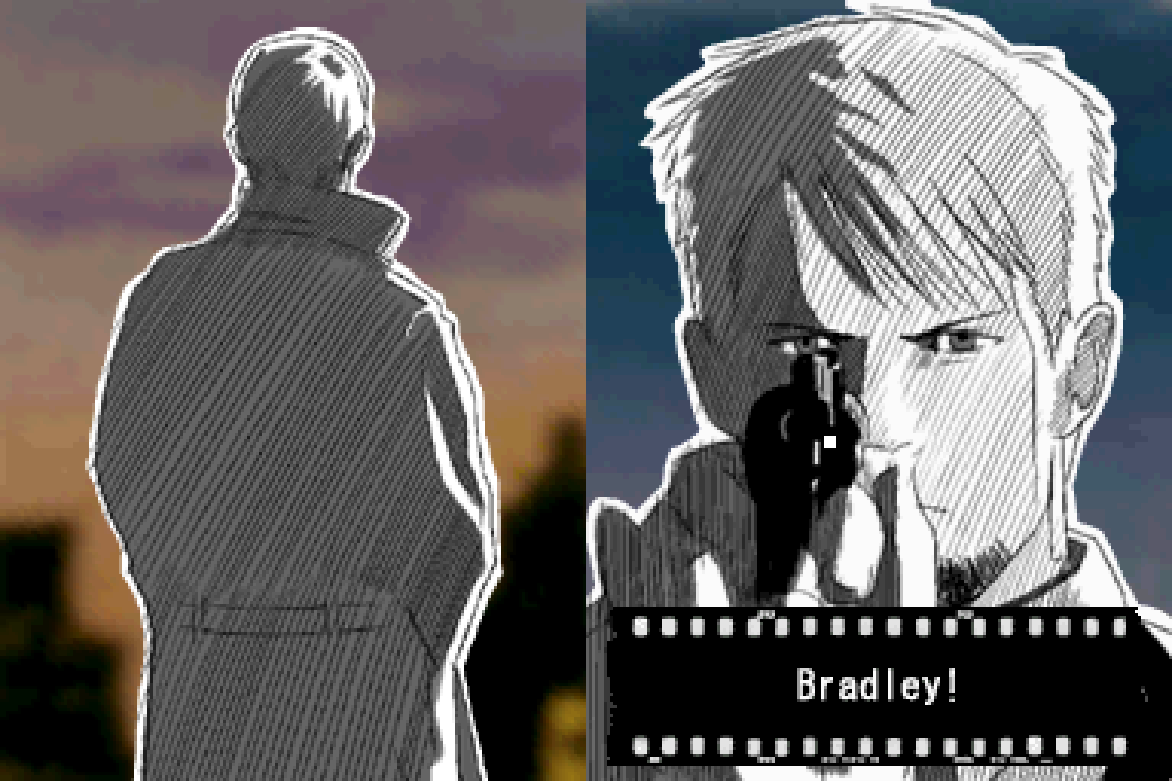
Just about every character in the game is similar, Kyle Hyde included; although we discover much about his backstory early on, smaller details about his personality, his interests are shown off sparingly and wisely. It’s almost an inverse of what we get with the other characters, and the little things are what make Kyle Hyde one of the highlights of the entire game. He is shown to be very grumpy and sardonic; his weary, exhausted view of the world doesn’t immediately endear him to most people and he is often downright rude. But rather than coming across as a completely unlikable jerk, it’s shown that he is actually pretty patient; his dismissive nature belies a caring heart, one that goes to great lengths to help others. The more time you spend with him, the more endearing he becomes; as weird as it may sound, the moment I found out that he enjoyed bowling, I had to stop and just smile to myself because the notion was just so adorable and charming.
The overarching plot of Hotel Dusk lines up with this layered and gradual approach; at its core there sits one large mystery with Kyle Hyde, his mysterious ex-partner Bradley, and a girl named Mila standing in the spotlight and the keys to this mystery are excellently woven into other mysteries. As one character’s story concludes it opens up additional doors for Kyle’s own story, so the plot always feels as if it has some sort of momentum. Dramatic stories intermingle so effortlessly with more grounded ones; stories of organized crime, art theft and betrayal, dance with tales of broken families, tarnished personal promises and our aspirations.
I dare not spoil the whole game for you (if it wasn’t clear already, I highly encourage you to give this game a shot), but Hotel Dusk concludes in a way that leaves a lot of threads hanging and untied. But I still left feeling fulfilled; Kyle Hyde’s goal is not to solve all of these problems and emerge triumphant as a hero. He is merely bringing these truths to light, giving them air to breathe so that the keepers of these secrets can push on towards their goal, with their heads held a little higher than before. It pairs and contrasts well with the rather gloomy, melancholic air that hangs around the game, that while life can be complicated and hard to handle, sometimes making it to another day can be enough.

Life is full of meetings and partings, we don’t always get to learn about what happens to the people we meet in our day to day lives. Will the guests of Hotel Dusk find what they’re looking for in the end? We don’t know, we’ll likely never know and that actually might be fine. This ties into the titular setting; hotels are a transient space, a pit stop or place of rest en route to a destination. As Kyle, we grow very familiar with the location and despite it being very run down, it becomes comfortable, disarming almost. The characters are all out of their element, in a place meant to be a retreat. When faced with their own pasts and their secrets, they open up and let those walls down. As a new day dawns, the characters continue on their respective journeys, refreshed and with a clearer perspective on what they need to do.
The fact that The Dusk feels like a very realistic location helps considerably to make it one of the best settings in video game history; it’s full of little details to help it feel lived in and not every room requires close examination. You’ll want to stop and examine things though when you can, as Kyle always has something weird to say about the most mundane of objects. Some objects are just interactable for the sake of it as well, or as mediums for game concepts that are usually tied to menus; the jukebox in the bar serves as the sound test for the game, for example. The fact that one of the few optional quests in the game sends you on a scavenger hunt for stars hidden around the hotel, is almost certainly the dev saying “Pay attention to your surroundings! Take it all in!”.
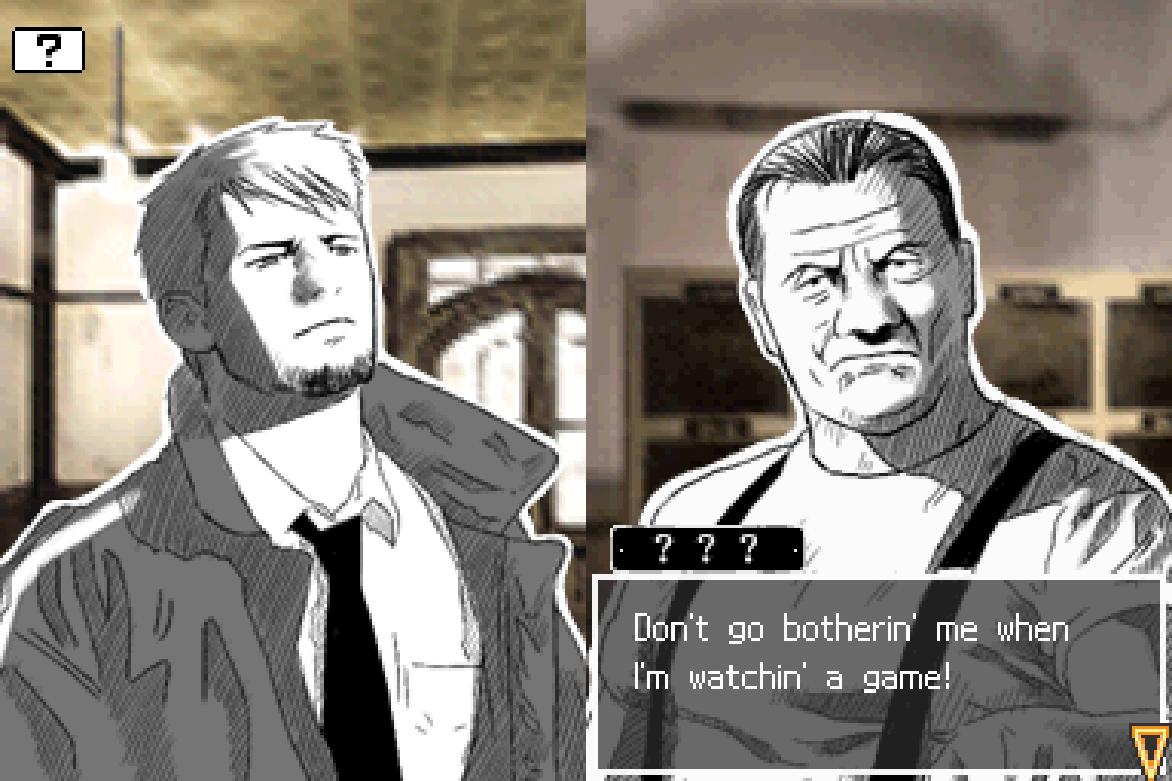
In terms of puzzle design, Hotel Dusk excels as well; each puzzle is simple, but they’re also logical and grounded in their solutions, giving them a real sense of place within the narrative. There’s an absence of the logical leaps you need to make in some other adventure games (although those games aren’t necessarily lesser for those design quirks) and while no puzzle is particularly challenging, it lends an authentic and immersive feeling to Hotel Dusk. Couple that with some truly ingenious usage of the Nintendo DS hardware and you have puzzles that are brief, but incredibly memorable.
In turn, the visual style is another aspect that makes Hotel Dusk stand out in your mind, even if you’ve never actually played it. Each character is drawn in a sketchy, penciled style, akin to chiaroscuro. Rather than being static, each character has animated portraits, with the movements being captured using rotoscoping techniques. It lends a lot of personality to each character, Kyle Hyde included, as detailed expressions are captured with each portrait, further aiding the already exceptional dialogue.
To wrap this ramble up somewhat, it’s apt, and almost certainly intentional, that the game takes place in close proximity to New Years. The guests staying at The Dusk are all facing the new year ahead of them with trepidation, with a sense of unease and uncertainty. There’s very few of them whose lives are on the track that they were hoping for and their goals, their dreams, are hanging in a precarious place. But as mentioned previously, the game concludes with them having newfound optimism for their own lives and goals.
It’s this energy that I want to walk into 2025 with, honestly. I didn’t intend for Hotel Dusk to be the first game I completed this year, it was sort of a happy accident that has instilled within me a hope for the year ahead. There may be aspects of my life that are bleak and my a lot of my desires rest beyond the horizon, out of sight. I’m under no illusions that things will always go smoothly and I understand that roadblocks are inevitable.
But that’s fine, that’s ok; it’s important to keep living, to keep moving onward despite it all. Hotel Dusk is a gritty, realistic, sombre detective story, with a protagonist that often doesn’t pull his punches. But it’s also about learning to cope, to live with our burdens, our regrets, our secrets and to live with the hope that one day we will be able to see the dawn and have our wishes fulfilled.
Thank you for reading! In Retrospect is where I talk about games that I find interesting, for one reason or another. It means a lot that you took the time to check out what I have to say. If you’re interested in supporting my work, then i’d appreciate a follow on my Bluesky.
I also have a Kofi so if you also want to support me, you can do so that way also!
 YunaNoire