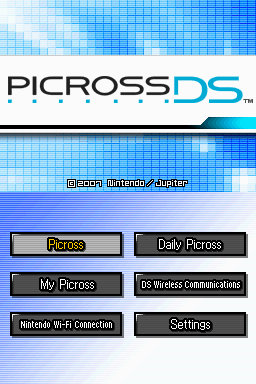
Nintendo’s Touch! Generations brand is something that I have been routinely intrigued by over the past few years, especially since falling in love with Cooking Guide: Can’t Decide What To Eat. Although… Hotel Dusk: Room 215 was actually the first game I wrote about that carried the mark, which was unbeknownst to me at the time since it was only a Touch!Generations game in North America. Initially conceived in response to the fast ageing population rate in Japan, Nintendo would instead use the label in the west to bring in a wider audience during the Wii & DS era. Something about the Touch!Generations brand and the multitude of titles it has been applied to has really enraptured my curiosity. But the topic of this article, Picross DS, is a game I have a long history with already.
As far as I can recall, my first real experience with Picross was the 3DS Virtual Console version of Mario’s Picross, which I had initially learned about from a feature in a magazine. But I think Picross DS was actually the first instance of me really falling in love with a Picross title and I remember buying it during a holiday, at that point it basically became my companion for all of the long car rides during said vacation. Released by Jupiter Corporation (who you may know for all of their other Picross titles or The World Ends With You) in 2007, it was actually only the second Picross title to be localised for the west. Mario’s Picross for the Game Boy apparently was not a commercial success, so further Nintendo nonogram outings were confined to Japan for a time.
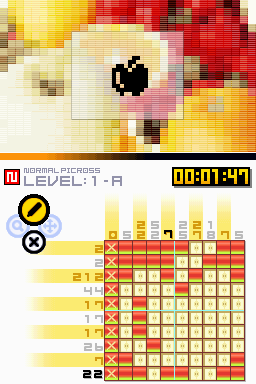
If you don’t know what Picross is, let me give you a brief summary on the basics; players are provided with an empty grid of varying sizes and by using the numbered hints surrounding the grid, you have to work out, logically, which squares can be filled in or left blank. In the end, if the player fills in all of the correct squares then it forms a picture! Typically this is done with a time limit, wrong moves will give you a time penalty and your mistake is automatically corrected. That is, unless, you’re playing in Free Mode, where there are no penalties, but you also don’t get told when you have made a wrong move at all, so you have to be just as, if not more, cautious than before, lest you find yourself hitting a dead end.
It’s a simple concept, one that I love a great deal, and Picross DS has an absolute avalanche of content for nonogram fans with over 300 puzzles available and of all the Nintendo released nonogram games I’ve played, these are some of the best they’ve ever done. It’s less to do with the puzzles themselves, since it is really, really hard to fuck up a Picross game and most people just enjoy the traditional format. It’s more so down to how these puzzles are presented instead as the many different levels of Picross DS have a specific theme, and each level has a skin appropriate for each motif. You can obviously play using the default look, but I find a great deal of charm in how, for the fruit themed level, each square on the grid is an apple, so when you select a square it chops the apple in half to fill it. Also, while each puzzle is a static image, once completed it is then animated, which is just really adorable and just adds to the sense of accomplishment you feel after finishing each puzzle.
These benefits may just be aesthetic but I think they go a long way to help Picross DS stand above later entries in the series, even all these years later. It’s hard to go wrong with nonogram puzzle games, no matter which title you end up choosing; you can find a lot of diverse executions of the same simple idea and even games themed around specific franchises or gaming companies. The extra aesthetic inclusions in Picross DS just stick in my mind to make it particularly memorable, beyond the compelling, engaging and elegant gameplay. The music follows suit, as while each track has largely been tuned for easy listening, there are some really good melodies here (an especially big fan of the ‘House’ track in Free Mode).
Picross DS also evolves from its predecessors by being on a system with a touch screen. Needless to say, touch controls work especially well here and they allow you to fill in lines much easier and much faster. Personally, I do actually prefer to use the button based controls, since it feels a little more accurate and it is just what I am used to. But I imagine for those unaccustomed to traditional video game controls, the intuitive nature of the touch screen lowered the barrier of entry considerably, as it basically feels like using a pen and paper.
Speaking of the touchscreen though, one bizarre thing about Picross DS are the inclusion of some touch based bonus games. There are three to unlock in each level and while the ‘Sketch’ bonus games, which require you to copy an image from the top screen to the bottom, feels appropriate for a Picross title, the other two seem weirdly out of place. ‘Catch’ sees you tapping moving squares within a time limit, while ‘Hit’ requires you to tap squares that will blink in and out, until you have met a certain threshold. These bonus games just always seemed a little weird to me, but the fact that they are here at all provides a little bit of texture to the game. I can only imagine they really wanted to sell inexperienced users on touch screen focused gameplay, beyond the relatively comfortable setting of regular Picross.
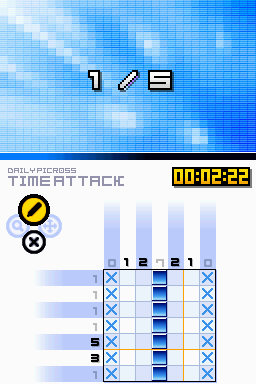
Outside of the traditional nonogram antics, Picross DS also introduces a Daily Picross mode. Daily modes are a common feature among Touch! Generations titles, which I believe is mostly thanks to the popularity of Brain Training, where the idea was mostly centred around self-improvement, making your brain younger by playing each and every day. With Picross DS, the concept kind of steers away from the typical Picross experience; each of the different daily puzzles are focused on doing it faster, with your overall grade improving as you reduce your time. These puzzles go by incredibly fast, lending well to the idea of daily play and I actually think the general idea of ‘Picross but Fast’ is an interesting one, something I haven’t seen tackled elsewhere before. Even if you don’t have time to get stuck into a full puzzle, the Daily Picross offers up a nice little nonogram nugget to satiate you.
Another novel feature is the option to create your own Picross puzzles; this obviously had much more use when you could share your creations online and download those made by others as well. I wish I had gotten some use out of it back when Nintendo Wi-Fi services were active. Similarly, I wish I had gotten to try the online competitive modes as well; because the idea of competitive Picross actually sounds super intriguing to me. With some additional research, it seems like these versus modes were speed challenges, tasking players with finishing puzzles before their opponents. You can also do these via Local Multiplayer… but I don’t really know anyone who would be willing to try that out with me. Maybe someday i’ll get my chance to experience Picross DS multiplayer, maybe someday.
There’s a bunch of other little things that make Picross DS such an interesting little title: you can send single puzzles as demos to other players, so you can spread the joy of nonograms to your friends, family and loved ones; the game has, for some reason, rumble support, which I sadly could not test for this article either, due to owning a DSi, which cannot use the DS Rumble Pak; in addition to the user created puzzles, there were a bunch of downloadable puzzles too, all of which are pulled from previous Picross titles, so back in the day you really could get your money’s worth here, Wi-Fi connection permitting. Small features like these go a long way to make Picross DS feel like an exceptionally well-rounded package to me, more than just your average Picross/Nonogram title.
–
Picross DS really is one of the best DS games to just sit back and relax with, preferably with a cup of tea or coffee, and maybe a sweet treat too. It’s perfect to play during a work break or just a lazy day off, it challenges the mind, offers a very orderly and logical sense of satisfaction as you start to see the puzzle take shape after spending many, many minutes building it up. It really does feel at home within the Touch! Generations brand, I think I could hand this over to my mum or my dad and they’d have a good time with it. The intuitive touch controls bridge the gap for anyone that might have difficulty with standard button based inputs and work especially well in the Daily Picross modes.
Jupiter Corporation would go on from Picross DS to make many, many more games in this now long-running series. Picross DS must have really got the ball rolling in the west, since we were seldom denied a Picross title ever again, by now there are so many to choose from on the Nintendo Switch alone. And that’s before you get to talking about all of the non Jupiter Corporation developed nonogram puzzles games. I’d say it’s still a pretty niche genre, all things considered, but you have plenty of options now to get your fix, many that I still need to try out myself.
I’ve at least tried out Picross e and Picross S for the 3DS and Switch respectively and while they do offer the same sort of enjoyable gameplay that nonograms are known for, there’s an overall lack of ambition, a lack of flair or innovation. Don’t get me wrong, you don’t need to reinvent the wheel when making a bloody Picross game, you can get a great deal of enjoyment from these games regardless of their additional inclusions. But I think that extra effort is just what really makes Picross DS the more compelling and more enduring entry in the series and genre.
While Picross DS lacks many of the quality of life adjustments that the newer games may have, and mostly just offers a traditional Picross experience, it still stands alongside its modern peers as worthy of your time. Smart, stylish UI design, graphical flourishes, some unique additional modes and even the ability to puzzle against a friend or stranger, that really marks Picross DS as something special for the console, the era and even today. The genre has perhaps come a long way but you just can’t go wrong with a classic like Picross DS.
Thank you for reading! In Retrospect is where I talk about games that I find interesting, for one reason or another. It means a lot that you took the time to check out what I have to say. If you’re interested in supporting my work, then i’d appreciate a follow on my Bluesky.
I also have a Kofi, so if you also want to support me, you can do so that way also!

 Yuna Noire